What Is Optical Contact Bonding?
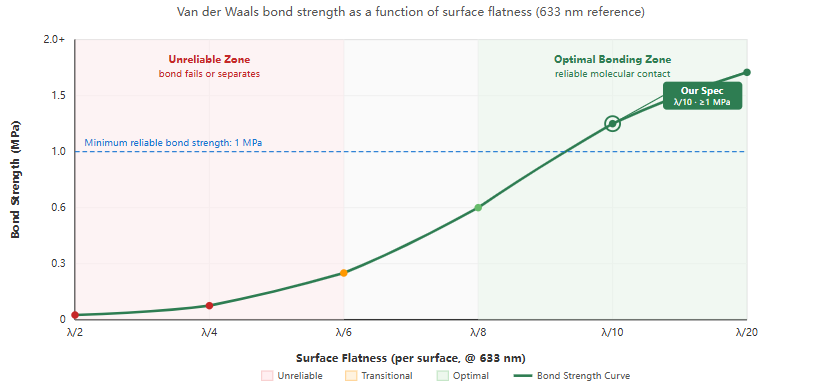
Optical contact bonding is an adhesive-free joining technique in which two precision-polished optical surfaces are brought into intimate contact and held together by van der Waals molecular forces — without any cement, adhesive, or applied heat. When both surfaces are sufficiently flat (typically λ/10 or better) and free of contamination, the intermolecular attraction across the interface is strong enough to create a permanent or semi-permanent bond. The resulting joint is optically transparent, introduces no additional refractive index discontinuity beyond the glass itself, and exhibits exceptional dimensional stability. Optical contact bonding is widely used in the fabrication of etalons, beam splitters, prism assemblies, and laser cavity components where adhesive-induced wavefront distortion or outgassing cannot be tolerated.
Process Capabilities
- Surface Flatness Requirement: λ/10 or better (per bonding surface)
- Surface Roughness (Ra): ≤ 0.5 nm (superpolished finish)
- Bond Strength: ≥ 1 MPa (van der Waals contact); up to 10+ MPa (hydroxide-catalysis bonding)
- Transmitted Wavefront Error: λ/10 – λ/20 across aperture
- Parallelism of Bonded Assembly: ≤ 2 arcsec
- Maximum Substrate Size: Up to 200 mm diameter
- Operating Temperature Range: –40 °C to +300 °C (material-dependent)
Compatible Materials
| 1 | Fused Silica | Corning 7980 / Tosoh ES-2000 |
| 2 | Quartz Glass | SCHOTT Lithosil Q / Heraeus Suprasil 1 |
| 3 | Borosilicate Glass | PYREX 7740 / BOROFLOAT 33 |
| 4 | Sapphire | C-plane / A-plane |
| 5 | Silicon | Float Zone / Czochralski |
| 6 | Glass-Ceramic | ZERODUR / PYROCERAM 9606 |
| 7 | Optical Glass | BK7 / N-BK7 |
| 8 | CaF₂ | UV-grade / IR-grade |
| 9 | MgF₂ | UV-grade |
| 10 | ZnSe | CVD-grade |
| 11 | Germanium | Single crystal / Polycrystalline |
Surface Finish Standards
- Flatness: λ/10 per surface (λ/4 minimum for contact bonding)
- Surface Roughness: Ra ≤ 0.5 nm (superpolish required for reliable bond)
- Scratch-Dig: 10-5 (laser-grade, per MIL-PRF-13830)
- Cleanliness: ISO Class 5 cleanroom bonding environment
- Bond Interface Inspection: Newton's rings / interferometric fringe inspection before and after bonding
- Post-Bond Flatness: Assembly TWE ≤ λ/10 guaranteed
Typical Applications
- Fabry-Pérot Etalons: Ultra-stable spacer assemblies with no adhesive layer
- Laser Optics: Intra-cavity windows, output couplers, and polarizers for high-power lasers
- Interferometry Components: Reference flats and beam splitter cubes for metrology instruments
- Gravitational Wave Detectors: Hydroxide-catalysis bonded mirror suspensions (LIGO-type)
- Space Optics: Adhesive-free assemblies for vacuum and radiation environments
- Optical Isolators & Retarders: Cemented-free crystal and glass assemblies
Custom Specifications
We support both standard van der Waals contact bonding and hydroxide-catalysis (silicate) bonding for applications requiring higher bond strength or elevated temperature stability. Custom assemblies can include dissimilar material pairs (e.g., fused silica to sapphire), multi-element stacks, and bonded assemblies with applied AR or HR coatings on external surfaces. All bonding is performed in a controlled cleanroom environment with full interferometric inspection at each stage. Documentation includes surface figure maps, fringe pattern records, and dimensional reports for every bonded assembly.
Bond Strength vs Surface Flatness