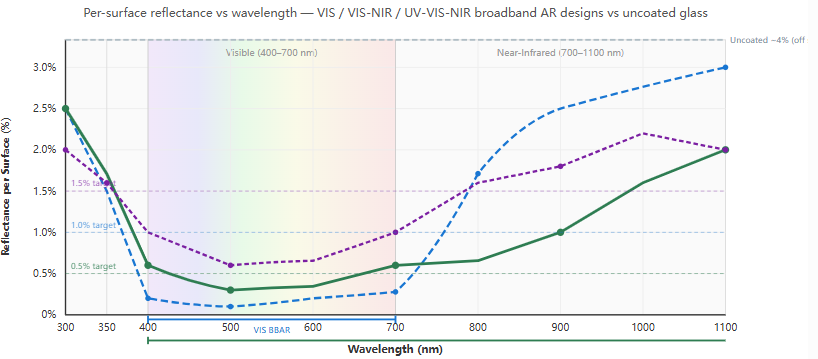
Broadband AR coating is used to reduce reflection across a wide wavelength range instead of a single design wavelength. It is suitable for optical glass, fused silica, quartz, sapphire, CaF₂, MgF₂, ZnSe, germanium, silicon and glass-ceramic substrates.
Available coating bands include VIS 400–700 nm, NIR 700–1100 nm, VIS-NIR 400–1100 nm, UV-VIS 350–700 nm, UV-VIS-NIR 350–1100 nm and extended NIR 600–1600 nm. Coating design can be customized by wavelength range, substrate, angle of incidence and reflectance target.
Broadband anti-reflection (BBAR) coating is a multi-layer thin-film design optimized to minimize surface reflectance simultaneously across a wide wavelength range — typically spanning 100 nm or more — rather than at a single design wavelength. Unlike a V-coat, which achieves extremely low reflectance (< 0.2%) at one specific wavelength but rises sharply on either side, a broadband design uses a more complex layer stack (typically 5–9 layers) with graded refractive index transitions to distribute the destructive interference condition across the full target band. The trade-off is a slightly higher minimum reflectance compared to a V-coat, but with dramatically better uniformity across the spectrum. This makes BBAR coatings the standard choice for white-light imaging systems, broadband laser platforms, multi-wavelength instruments, and any optical system where performance must be maintained across a range of wavelengths rather than optimized for a single line. Deposition is performed by ion-beam sputtering (IBS) or magnetron sputtering with real-time optical monitoring, ensuring layer thickness accuracy to ±0.5 nm and coating uniformity within ±0.5% reflectance across a 200 mm substrate.
コーティング性能仕様
Design Band
波長範囲
Ravg
Rmax
VIS BBAR
400~700 nm
< 0.5%
< 1.0%
NIR BBAR
700~1100 nm
< 0.5%
< 1.0%
VIS-NIR BBAR
400~1100 nm
< 1.0%
< 1.5%
UV-VIS BBAR
350 – 700 nm
< 0.8%
< 1.2%
UV-VIS-NIR BBAR
350 – 1100 nm
< 1.5%
< 2.0%
Extended NIR BBAR
600 – 1600 nm
< 1.0%
< 1.5%
Custom BBAR
Customer-specified
Design-dependent
Design-dependent
Layer count: 5–9 layers · Thickness accuracy: ±0.5 nm · Uniformity: ±0.5% R across 200 mm · AOI: 0°–30° standard
対応基材
基板
代表的な等級
1
溶融石英
コーニング 7980 / 東ソー ES-2000
2
石英ガラス
SCHOTT Lithosil Q / Heraeus Suprasil 1
3
ホウケイ酸ガラス
パイレックス 7740 / ボロフロート 33
4
光学ガラス
BK7 / N-BK7 / N-SF11 / N-LAKシリーズ
5
サファイア
C面/A面
6
CaF₂
UV対応グレード/IR対応グレード
7
MgF₂
UV対応グレード
8
ZnSe
CVDグレード
9
ゲルマニウム
単結晶/多結晶
10
シリコン
フロートゾーン/チョクラルスキー法
11
結晶化ガラス
ZERODUR / PYROCERAM 9606
層構造と設計
デザイン
層の材料
層数
堆積法
VIS BBAR
TiO₂ / SiO₂
4 – 5
IBS / マグネトロン
NIR BBAR
TiO₂ / SiO₂
4 – 5
IBS / マグネトロン
VIS-NIR BBAR
Ta₂O₅ / SiO₂
6 – 7
IBS
UV-VIS BBAR
HfO₂ / SiO₂ / MgF₂
5 – 6
IBS(イオンアシスト)
UV-VIS-NIR BBAR
Nb₂O₅ / SiO₂ / MgF₂
7 – 9
IBS
Extended NIR BBAR
Ta₂O₅ / SiO₂
5 – 7
IBS / マグネトロン
All designs optimized via needle synthesis and transfer matrix method · Custom AOI and substrate available
代表的な用途
Scientific Imaging: VIS-NIR BBAR on microscope objectives and spectrometer optics for broadband detection
Machine Vision: VIS BBAR on industrial camera lenses for consistent throughput across white-light illumination
Multi-Wavelength Laser Systems: VIS-NIR BBAR on shared-aperture optics handling 532 nm, 1064 nm, and 1550 nm simultaneously
Astronomy & Telescope Optics: UV-VIS-NIR BBAR on corrector plates and field flatteners for broadband sky surveys
Defense & Surveillance: Dual-band VIS/NIR BBAR on sensor windows for day/night imaging systems
Photovoltaics: UV-VIS-NIR BBAR on solar concentrator lenses and cover glass for maximum light harvesting
環境および耐久性基準
テスト
状態
標準
結果
接着
テープ剥離試験
MIL-C-48497A
剥離なし
摩耗
50ストロークの消しゴム
MIL-C-48497A
コーティングの剥離なし
湿度
95% RH · 49°C · 24時間
MIL-STD-810
水ぶくれが生じない
温度サイクル試験
–65°C ~ +125°C · 10サイクル
MIL-STD-810
ひび割れ・剥がれなし
塩霧
5% NaCl・35°C・24時間
MIL-STD-810G
腐食なし
レーザーによる損傷
1064 nm・10 nsパルス
ISO 11254
LDT > 5 J/cm²
溶解度
蒸留水・24時間の浸漬
ISO 9211-3
解散なし
Reflectance vs Wavelength: Broadband AR Design Comparison